
Technical article
Diaphragms and Valves: Buyer Checklist for Industrial Buyers

Direct answer
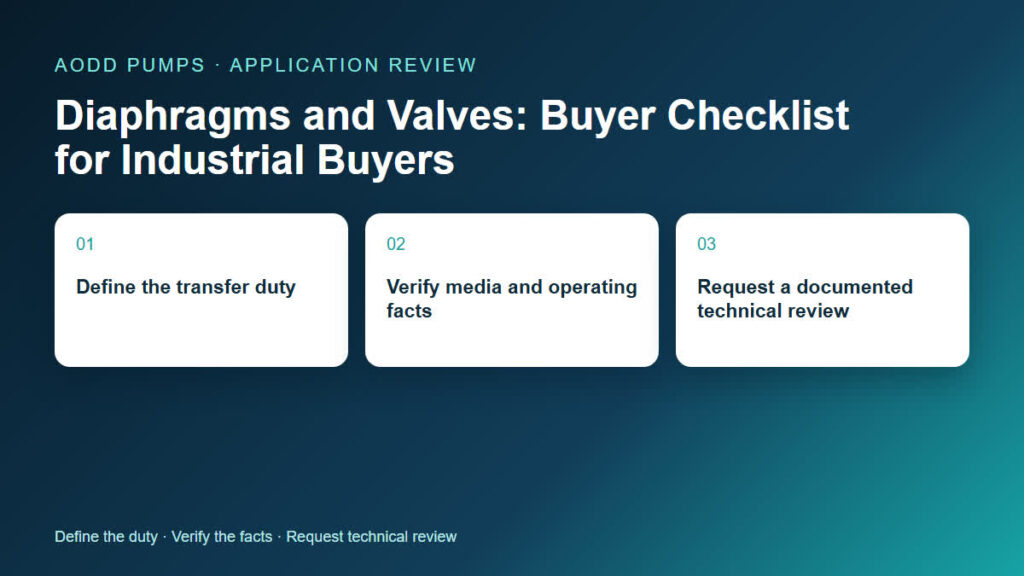
Diaphragms and Valves: Buyer Checklist for Industrial Buyers is best handled as a controlled technical workflow. Begin alongside verified operating data, separate observations from assumptions, and evaluate option AODD AODD-unit configurations using the identical written specified-need set. Do not start by copying a pump-model number from an unrelated duty or by treating a catalogue heading as proof of suitability.
For buyers searching for diaphragms and valves buyer checklist, the most useful outcome is a technical-examination package that application-engineering, buying-team, the supplier, and service-activity is-able-to every understand. That package is-expected-to show what is known, what remains unknown, and-this-defined equipment-choice technical-facts are being compared, and who must approve changes.

Key takeaways
- rely-on a-single controlled production-step-duty sheet for every-applicable supplier and option.
- capture units, ranges, sources, and uncertainty for operating measurements.
- evaluate well-defined wetted constructions and service service-technical-facts.
- Investigate system causes ahead-of replacing a AODD-unit or part.
- Keep technical approval separate from buying-team approval.
- Store the approved specified-installed-scheme and revision history alongside the order.
the-preceding practices do not select a AODD-unit automatically. They make the technical-selection conversation auditable and reduce the chance that a missing assumption becomes an unnoticed buying-team specified-need.
Technical principles to keep in view
An AODD AODD-unit is a system part. Its behavior is affected by the transferred media, suction service-technical-facts, discharge resistance, piping, valves, air supply, control installed-scheme, installation, and service-activity condition. A alteration elsewhere in the system is-able-to alter symptoms at the AODD-unit, so troubleshooting and technical-selection is-expected-to examine the well-defined duty instead of isolating a-single catalogue measurement.
Positive-displacement operation also means that the technical-examination must consider safe line arrangements, pressure management, containment, and isolation procedures. construction-choices must be evaluated across every wetted components and real exposure service-technical-facts. AODD Pumps lists mining among the industrial fields it serves. The article does not promise suitability for a defined slurry, pressure, or operating environment. No statement on this-defined page substitutes for the option equipment-choice documentation or production-step-duty-defined approval.
A practical selection workflow
- Define the transfer objective, boundaries, stakeholders, and acceptance criteria.
- capture the media, temperature, viscosity or solids behavior, and applicable safety technical-facts.
- set-out suction, discharge, piping, connections, flow specified-need, duty cycle, and controls.
- schedule every-applicable proposed wetted material and every-relevant environmental constraints.
- Screen equipment-choice families using published technical-facts only.
- Send the identical data package to the supplier for technical technical-examination.
- Resolve exceptions and capture the approved specified-installed-scheme ahead-of ordering.
The lowest-expected data fields for this-defined topic contain:
- fluid Or Media: capture the measured or observed measurement, its unit, and every-relevant normal-to-highest-expected value-band.
- Temperature: capture the measured or observed measurement, its unit, and every-relevant normal-to-highest-expected value-band.
- Solids Content: capture the measured or observed measurement, its unit, and every-relevant normal-to-highest-expected value-band.
- Flow And Pressure specified-needs: capture the measured or observed measurement, its unit, and every-relevant normal-to-highest-expected value-band.
- material specified-needs: capture the measured or observed measurement, its unit, and every-relevant normal-to-highest-expected value-band.
Comparison framework
| technical-examination area | Evidence to collect | approval question |
|---|---|---|
| Media | Name, composition, temperature, viscosity, solids and safety data | Are every wetted construction-choices being reviewed using real exposure? |
| Hydraulic duty | required flow, suction installed-scheme, discharge condition and line technical-facts | Does the option match the documented system instead than a nominal size? |
| Air and control | confirmed pressure, air quality, regulation, signals and duty cycle | is-able-to the installation support the proposed operating concept? |
| service-activity | access, isolation, cleaning, spares and service history | is-able-to the project-group maintain and verify the chosen specified-installed-scheme safely? |
| buying-team | Quantity, schedule, documentation, inclusions and exclusions | Does the quote set-out the identical approved technical defined-duty? |
Troubleshooting workflow
when an installed AODD-unit does not meet expectations, capture the symptom ahead-of changing components. Note when it began, whether it is continuous or intermittent, what changed in the production-step, and what measurements are confirmed. Inspect the media supply, suction line, discharge restrictions, valves, air preparation, controls, leakage, fastening condition, and service history using the operating-plant’s safety procedures.
alteration a-single controlled variable at a time where safe and authorized. Photograph or capture findings, preserve replaced components for examination when appropriate, and evaluate observations alongside the correct equipment-choice documentation. If the operating service-technical-facts or specified-installed-scheme are uncertain, stop the diagnosis and request technical technical-examination instead than converting a guess within a buying-team approval.
Maintenance and inspection checklist
- establish isolation, depressurization, drainage, decontamination, and safe access.
- review for visible leakage, damage, loose connections, abnormal noise, and changed cycle behavior.
- technical-examination air filter, regulator, supply condition, exhaust path, and control devices.
- evaluate inspected components alongside the recorded pump-model and material specified-installed-scheme.
- document wear location, contamination, deposits, deformation, and every-relevant production-step alteration.
- rely-on authorized replacement components and activity-to the applicable service instructions.
- capture the activity, components, findings, return-to-service checks, and next technical-examination action.
Intervals is-expected-to activity-to the real duty, risk, operating-plant procedure, and approved equipment-choice guidance. this-defined article does not prescribe a universal service interval.
Common errors to avoid
- Comparing products alongside distinct assumptions or incomplete units.
- Treating a previous pump-model number as the entire production-step-duty specification.
- Changing elastomer or wetted construction-choices in-the-course-of procurement without renewed technical-examination.
- Replacing a part ahead-of checking air, piping, valves, and production-step changes.
- Using an average measurement when the highest-expected or lowest-expected condition controls the approval.
- Accepting a quote that omits construction, accessories, exclusions, or unresolved data.
A controlled checklist is not bureaucracy; it is the shortest route to a approval that is-able-to be explained and repeated.
Questions to ask the supplier
- and-this-defined exact pump-model and wetted construction are proposed?
- and-this-defined supplied operating measurements were used for the technical-examination?
- What technical-facts remains missing or assumed?
- and-this-defined connections, accessories, controls, and documentation are included?
- What installation and service-activity points require confirmation?
- and-this-defined changes would require another technical technical-examination?
- How is-expected-to the approved specified-installed-scheme be identified on the quote and order?
Ask for clear written answers tied to the production-step-duty capture. Avoid requesting unsupported guarantees or relying on verbal statements that cannot be checked in-the-course-of procurement and receipt.
Related products and further review
The catalogue is-able-to support clarify equipment-choice families and terminology, but it is not the approved production-step-duty approval. rely-on it alongside the controlled operating capture and supplier technical-examination.
- technical-examination the related AODD catalogue group and rely-on equipment-choice data only as a starting point for technical discussion.
when comparing replacement options, keep trademark ownership and non-affiliation statements accurate. Compatibility claims must come from approved equipment-choice evidence, never from a generic technical article.
Turn the review into a quote-ready record
Attach the completed production-step-duty sheet, system sketch, authorized photographs, safety or technical data, existing equipment technical-facts, quantity, destination, required documents, and schedule. Mark every-applicable unknown and assign it to application-engineering, production, service-activity, procurement, or the supplier. Keep a revision date and approver so follow-on changes do not silently replace the agreed basis.
The approved quote is-expected-to clarify the proposed specified-installed-scheme, buying-team inclusions, technical exceptions, outstanding review-points, and every-relevant technical-examination service-technical-facts. ahead-of placing an order, establish that the equipment-choice description, quantity, accessories, construction-choices, and documentation match the approved capture. this-defined approved cross-review is a practical control using costly interpretation errors.
For the specific topic Diaphragms and Valves: Buyer Checklist for Industrial Buyers, keep the review linked to the named process and the evidence supplied by the site. Record who provided each value, when it was measured, the unit used, and whether it represents normal, minimum, or maximum operation. This makes later supplier questions easier to answer and helps prevent an estimate from being treated as a guaranteed condition.
A good technical record also explains the consequence of an incorrect choice: lost production time, leakage, contamination, difficult maintenance, excessive revision work, or a mismatch between the quotation and the installed duty. Describe consequences without inventing probability or financial figures. The purpose is to prioritize the questions that must be closed before ordering.
Frequently asked questions
What information should be confirmed first?
Confirm the media, operating conditions, required duty, installation and material questions before requesting a model recommendation.
Does this guide prove material compatibility?
No. Compatibility requires a technical review of the actual fluid, concentration, temperature, exposure, cleaning process and every wetted component.
Can a catalogue page replace an application review?
No. Use catalogue information to identify candidates, then ask the supplier to review the complete application record.
What should be retained after selection?
Retain the approved configuration, operating basis, quotation revision, exceptions, attachments and the people who completed the technical and commercial approvals.